


 Trampoline park safety in 2025
Trampoline park safety in 2025
Trampoline parks first appeared in 2004 in Las Vegas, and since then their popularity has exploded worldwide! What was once just a jumping area with a few basketball hoops and a foam pit has become a true multi-activity center. Today, parks offer far more than trampolines: dodgeball, jump towers with airbags, tumbling lanes, obstacle courses, interactive games, ninja courses, walk-the-wall activities… There is something for everyone!
This growing success attracts a diverse customer base of all ages and skill levels, for activities that are social, recreational, and athletic. However, the more “jumpers” there are, the more accidents tend to increase—sometimes with serious consequences. It therefore quickly became essential to establish safety rules. Each country then worked to create either a standard or a guide to best practices to regulate the activity. In France, an initial experimental standard was introduced in 2018. It was then replaced by a European and international standard, EN ISO 23659, in 2022.
So, are trampoline parks dangerous? Absolutely not, provided they are well designed, properly inspected, and used responsibly. Thanks to strict safety standards and high-quality equipment, today’s trampoline parks can offer a fun and safe experience for everyone!
Design and safety in trampoline parks: prevention first
Trampoline park manufacturers have a clear mission: to design entertaining spaces while minimizing risks for users. To achieve this, they develop robust structures and set precise rules of use, specifically designed for the safety of “jumpers.” Unlike competition trampolines, where the goal is often to jump as high as possible, the idea in a leisure complex is to move from mat to mat safely, without seeking extreme heights.
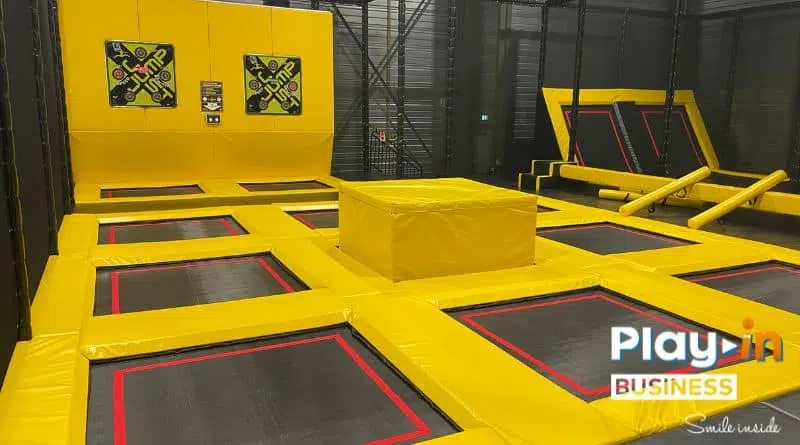
The jumping mats used in parks are designed to provide a controlled bounce. Their very fine mesh, generally black, is quite different from that of sports trampolines, which have a wider mesh and a white color for higher jumps. This technical choice helps limit bounce height: the lower the jumps, the lower the risk of a bad landing, thereby reducing the risk of injury.
Thanks to this approach, trampoline parks manage to deliver a fun experience while maintaining a high level of safety.
Safety materials and accessories: the essential duo for worry-free jumping
The materials used in trampoline parks play a key role in jumpers’ safety and comfort. The “black” jumping mats are designed to limit jump height while ensuring a comfortable landing, even in the event of a fall onto the back. This type of mat, made from a durable blend of polypropylene and synthetic fibers, is specifically selected for its longevity and robustness.
A minor drawback of these mats is their slightly slippery surface. To address this, parks provide non-slip socks—an essential accessory for safer jumping. Thanks to these socks, jumpers benefit from better grip, which improves jump precision and footing stability, thereby reducing the risk of falls.
It is important to keep in mind that most visitors are not experienced athletes. They come to relax, have fun, and be active in a safe environment. That is why trampoline parks, aware of this largely novice customer base, implement—or even enforce—strict usage and safety rules to ensure a pleasant and risk-free experience.
Essential rules for a safe jumping experience
Compliance with safety standards: the foundation of every trampoline park
In most European countries, the EN ISO 23659 standard governs the design and operation of trampoline parks. This standard sets strict requirements to limit risks, both in construction and in day-to-day management. Requirements include, among other things, the size of the jumping mats, the quality and thickness of impact-absorbing surfaces, the height of protective padding, and the dimensions of foam pits and airbags. The goal? To allow players to have fun while taking measured risks, in a controlled and safe environment.
Risk analysis and operating procedures: the role of operators
Even before opening, the operator must work hand in hand with the manufacturer to carry out a thorough risk analysis. This step helps identify potential hazards and develop standardized operating procedures (Standard Operating Procedures – SOP). These SOPs define the conditions of play, including:
- Minimum age of participants
- Maximum park capacity
- Permitted and prohibited tricks to limit the risk of injury
- Staff qualifications and skills to ensure adequate supervision
- Supervision conditions for optimal oversight of jumpers
These golden rules ensure continuous control over how the facilities are used.
The “single jumper” rule: avoiding double bounce
One of the key safety rules is to avoid having two people jump on the same mat. The “double bounce” phenomenon can unpredictably amplify jump height and lead to violent impacts on landing. For this reason, trampoline parks are strict about enforcing this rule, and park capacity is adjusted to the number of mats to prevent overcrowding.
Following the basic rules: strict supervision
Finally, other common-sense rules complement the safety measures:
- Do not run in the jumping areas.
- Do not push or touch others while jumping.
- Avoid sitting on the mats or hanging from the nets and basketball hoops.
The park manager must ensure these rules are followed at all times to guarantee a fun and safe atmosphere for all jumpers.
Supervision and training: ensuring safety through expert oversight
Each area of a trampoline park must be monitored by qualified staff responsible for enforcing safety rules. This presence is essential: good supervision significantly reduces the risk of accidents, especially at critical times such as the first minutes of play, when enthusiasm is high, and the last minutes, when fatigue increases.
Supervision adapted to the size of the park
A park’s capacity is defined by safety standards. For example, the XP S52-370 standard recommends 1 jumper per 10 m² and one supervisor per 32 jumpers. In a 500 m² park, this means a capacity of 50 jumpers with at least 2 supervisors, enabling optimal monitoring while ensuring profitability.
International reference standards
In addition to European standards, guidelines such as PAS 5000 (BSI) provide specific recommendations for UK parks, with similar results in terms of safety.
Accident prevention: raising awareness to protect
Rather than relying on a liability waiver, many parks show a safety awareness video before each session. This initiative significantly reduces accidents and reminds visitors of best practices for safe and enjoyable jumping.
Safety and best practices in trampoline parks
In summary, a well-designed and well-operated trampoline park does not present more risk than any other leisure activity. To ensure a safe and enjoyable experience, several elements are essential. The design must be developed by specialists, with a precise risk analysis to adapt the rules accordingly. These rules of play must be clear, understood, and accepted by all jumpers before each session. The presence of trained staff, in sufficient numbers to cover all areas, strengthens safety, as does regular maintenance of the structures. With these best practices in place, a trampoline park becomes a space for enjoyment and relaxation for everyone.
Would you like to learn more about creating a safe and high-performing trampoline park? Contact us today to discuss your project and create, together, a safe and entertaining space for your future visitors!