



 The Predicted Demise of Foam Pits in France?
The Predicted Demise of Foam Pits in France?
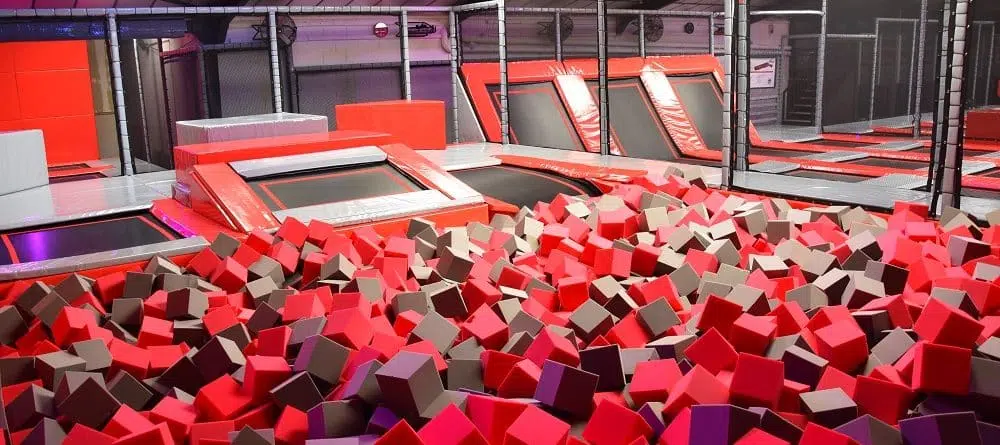
For several months now, no new foam pits have been authorized in trampoline parks in France. Why? The foam used (polyether) does not comply with fire safety requirements. It is currently not possible to find foam that is properly fire-rated (M3) and guarantees adequate cushioning. We published a blog in October 2020 to propose an alternative approach to fire safety, but the blockage appears to be definitive.
Why are Foam Pits Being Questioned?
Because behind this non-compliance lies another reason: several serious accidents, including a fatal one in the North of France in 2018, have occurred in foam pits. It seems that the Civil Security Directorate took advantage of this to request the refusal of all foam pits in new trampoline parks.
So, are foam pits really dangerous? If there’s one place that feels safe, it’s a pit filled with soft foam where one is tempted to push their limits. And that’s the problem: because they feel perfectly safe, jumpers will attempt overly complicated somersaults. The rotation speed then becomes too high for the foam to cushion properly. If the head hits first, cervical injuries can occur.
Limiting Risks: A Complex Equation
Some manufacturers limit the amplitude of jumps with smaller beds, different springs, and no podiums or platforms for jumping from higher points. Prior supervision and information—or even training—of jumpers significantly reduces accidents. However, this does not guarantee the absence of accidents, and firefighters were not convinced.
The Airbag: The Ideal Replacement Solution
There is a simple solution: replace the foam pit with an airbag, a large inflatable structure that ‘absorbs’ the jumper at the end of their fall. The airbag is made of fire-compliant vinyl, it is easy to clean, it does not disintegrate like foam, it automatically regains its shape very quickly, multiple jumpers can jump simultaneously on large airbags, it can take any possible shape, and its lifespan is much longer than that of foam pits.
While its initial purchase cost is high, the maintenance cost of an airbag is much more attractive than a foam pit: no more constantly rearranging foam blocks after several jumps, drastic reduction in maintenance costs, and mobile phones and glasses can no longer disappear to the bottom of the pit… Many operators are now opting for an airbag in their jump pits.
Is this, then, the end of foam pits in France?
For trampoline parks, it seems so. Professional associations and unions have not taken up the issue, operators are simplifying their lives by replacing their foam with an airbag, and jumpers are adapting…
There will certainly be a study on accident rates in trampoline parks in the coming years, and I hope we will see the accident rate decrease even as the number of participants continues to grow. This will undoubtedly be due to the professionalization of the sector, better training and information for jumpers, improved supervision, and we hope very soon, new European standards concerning the design and manufacture of trampoline parks.
But if the number of foam pits decreases along with the accident rate, there is little chance of seeing new foam pits in France in the coming years.